Wednesday, 30 November 2016

Numbers are Everywhere

       You know when you're learning something new, you just have to write it down everywhere you go? Children do the exact same thing. Learning letters of the their name means writing their name everywhere they go; in the sand, in the mud, with sticks etc. Ever realize they can do the same with learning numbers too?
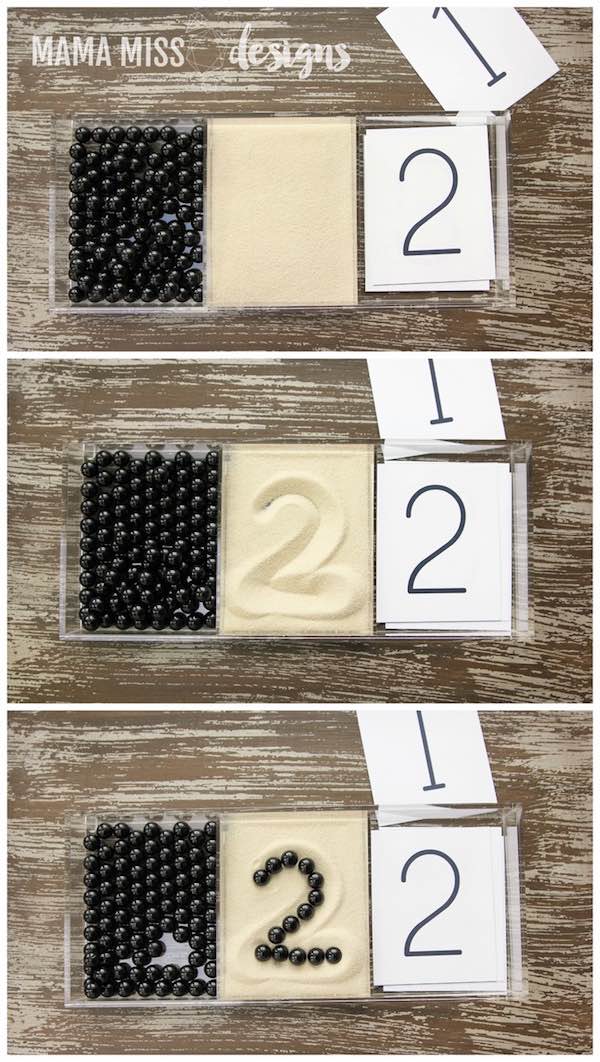
        Earlier, we talked about how children can represent numbers using different objects and items found outside, at home, in the classroom etc., but what about using natural materials as a canvas instead of paper? Try setting up a sand area, and place a few brushes inside along with a number.

        Children can practice writing numbers in the sand, mud, anywhere they please. Now, add in some beads. They can choose to make a number using the beads separately, they can also use the beads and sand and make a number i.e.; 1 in beads, 0 in sand etc. Now give them materials and ask how many ways can they write a number using different materials. The more they can make, the more they will familiarize themselves with the numbers. One can extend this activity by creating sand paper numbers. Using the texture, children can close their eyes tracing the shape of the number. By receptively doing this, they become familiar with the shape and outline helping them learn numbers.


Resource links
http://lemonlimeadventures.com/10-sensational-sand-play-ideas/
http://www.pequeocio.com/aprender-numeros-montessori-ideas-caseras/?utm_source=Pequeocio+Newsletter&utm_campaign=a508d965a4-RSS_EMAIL_CAMPAIGN&utm_medium=email&utm_term=0_3f70684ed9-a508d965a4-388827949

Representing Numbers Game

      What a better way to have children learn math skills than to play interactive games! They're easy to make especially if using objects around the house or classroom, and would make great prompts that would allow children to problem solve on their own, move at their own pace and express their creativity. 
       The example listed below demonstrates an activity done by educators for young children. To have the children practice their counting, they left out little trees and cones with corresponding numbers - the children then would have to use the materials provided in the pile, in this case pom poms and little red buttons. In the order of the sequence, students were able to additionally understand that they had to add a single new unit to every number, displaying progression below. This activity perfectly ties in the previous posts posted below; about extending learning through books and counting ( Ten Black Dots) and using different objects to present numbers.
       By engaging children in interactive games, they are unconsciously teaching themselves theory and building their theory by applying them. Games are a great way to motivate children who really don't want to do homework !


Resource links
http://www.pequeocio.com/aprender-numeros-montessori-ideas-caseras/?utm_source=Pequeocio+Newsletter&utm_campaign=a508d965a4-RSS_EMAIL_CAMPAIGN&utm_medium=email&utm_term=0_3f70684ed9-a508d965a4-388827949


Ten Black Dots

         Ten Black Dots by Donald Crew is a wonderful book to that helps children learn counting from 1 to 10. With the colourful visuals that allow children to follow along and get involved in the book, it's no wonder children and classes enjoy it to much.


          The black dots on each page, can act as a counting tool for children who are just beginning to count, by using their fingers or even for older children who may be learning addition and subtraction. The options are endless when it comes to involving your child in reading. One can cut out 10 black dots for their child to use while reading a book ( matching number of dots on page), or extending the activity by asking children how many more black dots they may need to reach 10 dots. You don't even have to use black dots, but change to what is around the home; beans, candy, squares, bears etc. For even older children, you can even invite them to make their own Ten Black Dots book to share with perhaps a younger student who may be learning counting. It incorporates their creativity, and ideas into one product that can help out another student.


Resource links
http://www.scholastic.com/teachers/book/ten-black-dots#cart/cleanup
https://www.youtube.com/watch?v=myhYN-mFW60

Saturday, 26 November 2016

Number Literacy


         For many children have a hard time connection numbers to words when seeing the number in number form and word form. Visually seeing it can be very helpful for young children, who have a hard time understanding the value a number holds, and that numbers and words are equal but written differently. 
         In the photos above, classroom educators allowed for children to find natural objects outside that represent a number, and allowed for them to create their own number board, featuring a visual of the number, the number in number form, and in written form as well, to help them connect numbers to words; numeral literacy. This idea can most definitely be adapted for older children; by perhaps making this a game to match the words, numbers, and visuals, or words and numbers. This strategy is a very unique method that will challenge your child to find objects around them, and also count in order to match.

Resource links
http://prekandksharing.blogspot.ca/2012/03/organic-materials-and-learning.html

Counting Numbers and Representation

                                  Counting With Ten Frames
            Counting with Ten Frames is a a very effective strategy to help support children and their counting. Once learning number up until 10 has been achieved, adding 20 frames and eventually 30 frames can easily be added to increase difficulty. Following the Reggio Amelia Approach, parents and educators can extend their child's learning but using natural objects within the classroom, outside or at home. Instead of using the regular ten frame, perhaps making a natural ten frame out of sticks, string, rocks etc. Furthermore, the ten frame can be used in more than one way, perhaps by having each object in each space represent a 1 to 1 representation, that each object in each space represents a number, and that if a whole frame is filled, that it means there are ten objects. Or, for children who may understand counting to ten, but may have a hard time imagining representation of the numbers can practice with finding objects that represent each number in each frame. 
           The nice thing about ten frames are that they can be made everywhere. Using household objects, sticky notes, tapes, etc, it is simple to make and simple to adapt depending on the age of children. But it can be adapted in many ways. Ie; making them larger so children can use their bodies to represent numbers, smaller to use very very small objects. The possibilities are endless with the use of your imagination! 
           The Wonders Of Learning Blogspot is a wonderful interactive way to see 


Resource links
http://thewonderoflearning.blogspot.ca/2013/01/counting-beautiful-materials.html


Welcome!

         Welcome fellow readers! I am so excited to be sharing with you my resources for counting. As many of you may know, number sense is one of the first things that a child learns academically, even before formal schooling. We often see this beginning in their toddler years and it carrying throughout the years. Specifically, counting sets a strong foundation for learning other math skills, and is essential in our every day life.
          As a parent or educator, it is often hard to know how to support students with their counting skills when they are first developing. The idea of a number and value is very abstract to young children, and often we need extra reinforcement to help them. My goal through this blog, is to provide you with many resources, methods, and ideas that may help you help your child developing counting skills. The internet is a wonderful place that offers many suggestions and experiences for not only children but for parents and educators looking to teach. I hope this blog finds you well, and you learn as much as I do through these wonderful resources.

Best regards,

An Mai